

The Vision is Clear. The Journey is Not
Why ServiceNow Must Reconnect Platform Ambition to Enterprise Buying Realities

As CMO, Colin Fleming achieved great success at ServiceNow. His recent departure to OpenAI says a lot about the scale of the challenge facing the next generation of enterprise platform companies.
During his time, Colin helped dramatically elevate ServiceNow’s market presence and strategic relevance. The “Put AI to Work” campaign has successfully repositioned the company into the centre of the enterprise AI conversation, while the collaboration with brand ambassador Idris Elba has helped humanise and amplify that message at global scale.
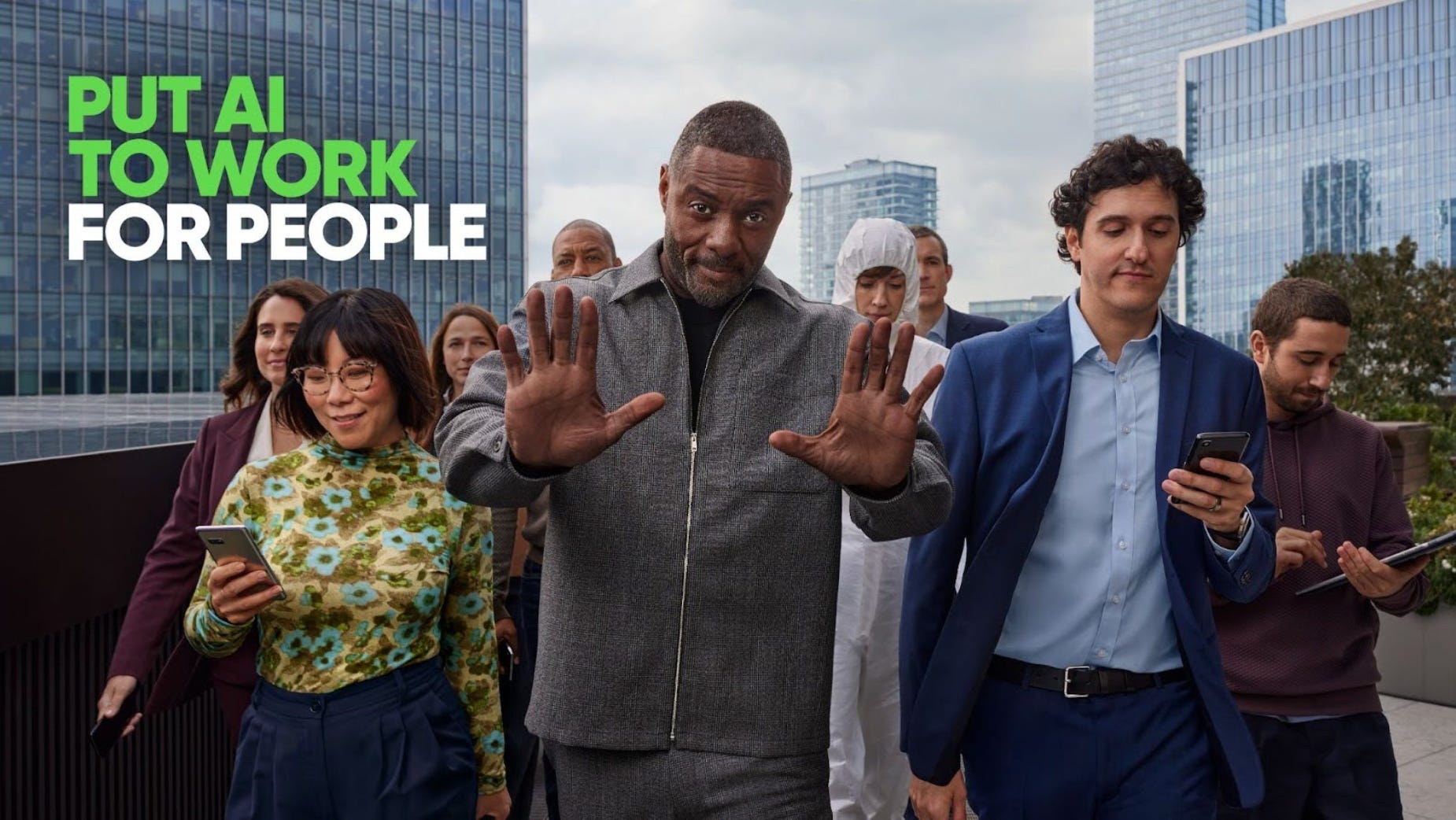
So ServiceNow has largely won the first battle. The market now understands the company matters, technologists are increasingly recognising the broader architectural direction toward PaaS and enterprise orchestration, and investors are now trying to comprehend the scale of the opportunity sitting in front of the business.
But awareness is not the same as understanding and I think a translation challenge remains. That means more work is required to help customers, partners and even internal teams understand where to begin, how the platform fits together, and how enterprises practically move from today’s operational complexity toward their own AI-enabled futures.
ServiceNow has evolved beyond the category leader that originally made it successful, but not yet escaped the gravitational pull of the category itself. I don’t see that as a bad thing. No serious technology executive now sees it as simply an ITSM or ticketing platform. But neither is it easily understood en masse as purely a workflow company, a CRM vendor, or even an AI story. Their strategic expansion has become both a great strength and their greatest communication challenge.
As enterprises move toward an agentic future, ServiceNow definitely has a strong claim to the emerging operational execution layer category. The continuing difficulty is that enterprise buying structures still reflect the fragmented technology models of the past. Procurement remains dispersed across disconnected buying centres, while customers continue evaluating technology through narrower category lenses that no longer fully reflect how modern platforms operate, i.e. the ServiceNow vision. The inheritance for the next CMO is therefore not an awareness problem, but a translation problem. Here are a couple of examples.
Firstly, ServiceNow appears to understand their larger destination clearly. The challenge is that it has heavily weighted the market narrative toward the scale of the opportunity, without an equally aggressive focus on maintaining the base and winning the decomposed competitive battles occurring at the individual layers of enterprise technology where customers are continuing to make buying decisions.
By that I mean, each of ServiceNow’s major offerings is strategically valid. Each addresses a real market problem, competes credibly with category incumbents and has the potential to generate meaningful long-term growth. But some of them are getting lost in the noise. The challenge is not the logic of the portfolio itself. It is the operationalisation of the story surrounding it.
ServiceNow has spent several years building a more unified NOW Platform narrative, and the Agentic Blueprint presented at Knowledge 2026 was an important step forward. It helped structue an increasingly broad platform into clearer conceptual categories.
But simplifying the platform is not the same as simplifying the customer journey into the platform. Enterprise transformation, to this point, rarely begins with a platform strategy. Organisations enter through immediate operational pain points. For one enterprise, that may still be ITSM modernisation. For another, it may be security operations, customer workflows, identity governance, regulated industry processes or increasingly CPQ, as disruption reshapes traditional CRM markets.
While these workloads solve very different operational problems, they are ultimately just entry points into a much larger opportunity sitting beneath the enterprise itself. The next marketing challenge may therefore be less about product positioning and more about journey orchestration. That requires more of a focus on helping organisations understand not just where to begin, but how one operational challenge progressively connects to a broader AI-enabled execution model over time.
Secondly, from a buyer perspective, the company is now competing with almost everyone. That was unclear just a few years ago. Not today. Hyperscalers are directly entering executive AI conversations, often with a cleaner path. Identity vendors are experiencing a resurgence driven by agentic AI and machine identities. Traditional workflow and BPM vendors remain deeply embedded in regulated industries. CRM is obvious. And frontier AI companies are reshaping customer expectations faster than enterprise software sales cycles can realistically adapt. Now security. That creates enormous pressure across the broader ServiceNow ecosystem.
Internal sellers are increasingly expected to navigate highly specialised domains that cannot simply be collapsed into a single platform conversation. CRM cannot be sold like ITSM. Security is a very difficult sell for generalists. CPQ may generate short-term growth opportunities, but it is probably too specialised to become the primary pathway through which most enterprises discover and expand into ServiceNow’s broader operational execution model.
Partners are simultaneously being pushed to evolve from implementation channels into transformation orchestrators, and resisting. Customers, meanwhile, are being asked to absorb and operationalise a pace of innovation arriving faster than most enterprise digestion cycles naturally allow. Yet, as we saw at K26, the market narrative continues accelerating regardless. It’s exhausting.
The challenge for ServiceNow is therefore no longer simply innovation. It is more about selectively, not collectively, re-aligning product ambition with sales capability, partner maturity and customer readiness at a time when the entire enterprise technology market is converging faster than its traditional operating models were designed to support.
Thirdly, they could rethink what constitutes a valuable customer reference in the AI era. Organisations such as Orica and Standard Chartered are undoubtedly important transformation stories. But they have also become ubiquitous across the broader technology ecosystem, especially in Asia Pacific. The same organisations now appear repeatedly every year across hyperscaler, AI, security, platform and consulting conference narratives, often simultaneously collaborating and competing with one another in the same customer environment.
At some point, these references stop feeling like differentiated customer stories and start feeling like isolated ecosystem case studies. The challenge is that most businesses are nowhere near that level of transformation maturity, operational scale or investment sophistication. What many normal customers increasingly need are more relatable transformation journeys. Organisations still navigating fragmented systems, regulatory constraints, operational debt and incremental progress toward AI-enabled execution. (Like the State of Hawaii guy from Knowledge).
In a market still trying to understand how AI operationalises inside the business, authenticity, trajectory and practical progression may now resonate more strongly than another perfectly polished North Star example.
Fourthly, most enterprises are now carrying decades of accumulated operational complexity in the form of duplicated processes, disconnected systems, fragmented approvals, manual interventions and regulatory overlays. These thousands of small inefficiencies have compounded over years of technology expansion and are especially prevalent in heavily regulated industries where platforms such as Pegasystems and Appian have traditionally thrived managing process-intensive operational environments.
This kind of operational complexity has traditionally been framed purely as a problem statements ranging from bad technical debt, to bureaucratic burden (red tape), and legacy process to be removed through large-scale transformation programs. But I’ve always felt that view is way too blunt and misses something important.
Much of this complexity represents years of accumulated institutional knowledge, embedded operational logic and regulatory adaptation that the right people in the right room can still unlock. In many ways, it resembles crude oil. It’s unrefined and difficult to work with yet still immensely valuable once properly extracted, analysed and refined. The problem has never been that this complexity existed. The problem was understanding how to surface it, structure it and translate it into operational value.
This is where their capabilities in process mining become strategically important. Not simply as observability tools, but as discovery engines capable of exposing how work actually happens across fragmented systems and disconnected teams. They can surface the invisible operational friction that traditional transformation programs often fail to identify. In that framing, Agentic AI is not actually the starting point. It is the starting point of refined complexity.
This is an area that makes sense, to they and their partners, as to their greatest long-term advantage. The company performs best in environments where complexity, regulation and organisational fragmentation already exist. And those are precisely the environments where hyperscaler-only approaches and isolated AI tooling often struggle to operationalise meaningful outcomes.
So I think the next CMO inherits a role that looks less like traditional enterprise software marketing and more like enterprise systems diplomacy. The task is no longer simply generating demand. It is helping organisations understand where to begin, how to progress, and why the operational complexity already sitting inside their business may actually contain the blueprint for their AI future.
That will require a structural evolution in go-to-market strategy itself, both globally and regionally, involving greater sales specialisation, stronger industry-led motions, more relatable customer references and clearer transformation pathways. It cannot achieve its full potential by trying to sell everything everywhere all at once. It is more likely to win by helping organisations move from one solvable operational problem to the next logical stage of maturity.
The irony of course is that ServiceNow sells execution, yet its own next phase depends on whether it can execute its strategy with enough focus, structure and discipline to carry the market with it. Because the company is not wrong about where enterprise technology is heading. They are absolutely right. It’s just that in many ways, it is earlier than much of the market in recognising that the future will be defined less by standalone applications, and more by orchestration of operational decision-making across fragmented environments. As an example, see my recent post on IBM to see what this means for Security.
But seeing the future and operationalising it are two very different things. They do deserve success. For that to happen, the vision now has to become consumable for customers, repeatable for sellers, and believable for partners.
And finally, I can’t wait to see what Colin helps shape next at OpenAI. But leaving the industry with Idris Elba performing at the ServiceNow Knowledge 2026 afterparty at The Sphere in Las Vegas feels like a fitting final scene.