
The Future of Campus Platforms
How to Align Digital Twins, Networks, and Service Layers Through a 3-Layer Platform Strategy

Last month I wrote about the convergence of three distinct platform layers (The New Digital Campus). Basically, a digital twin for context, a network for sensing, and a service platform for action. I didn’t mean it as a slogan. I meant it as a pattern that is emerging naturally wherever physical and digital systems are forced to coexist.
Every major transformation wave eventually reduces to architecture. And the same is happening here. If the last twenty years have been about digitising processes. The next ten will be about digitising environments. Those places we live, work, and move through. And in doing that, we’re actually building three simultaneous control planes that each see the world differently.
The digital twin sees space. The network sees motion. The service platform sees purpose.
Each is essential, but none can govern alone. The twin without the network is static. The network without the service layer is blind. The service layer without the twin is contextless. The art, and the next decade’s leadership challenge, lies in learning how to align them. Because context without sensing is theory. Sensing without action is noise. And action without context is chaos. Let’s look at each in turn.
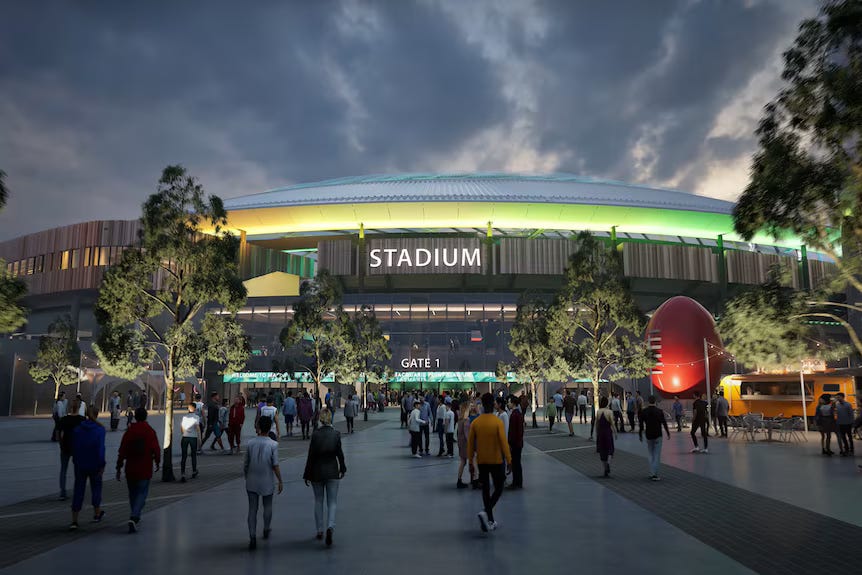
Imagine match day at the new Macquarie Point Stadium in Hobart, or at Brisbane’s future Olympic venue rising at Victoria Park for 2032. Whether it’s thirty thousand fans or a hundred thousand, half a dozen entry gates or twenty. At these venues, every part of the environment comes alive. Food and merchandise stalls, floodlights, elevators, big screens, turnstiles. Each one behaves like its own system, yet all of them share, and must operate within, the same physical reality.
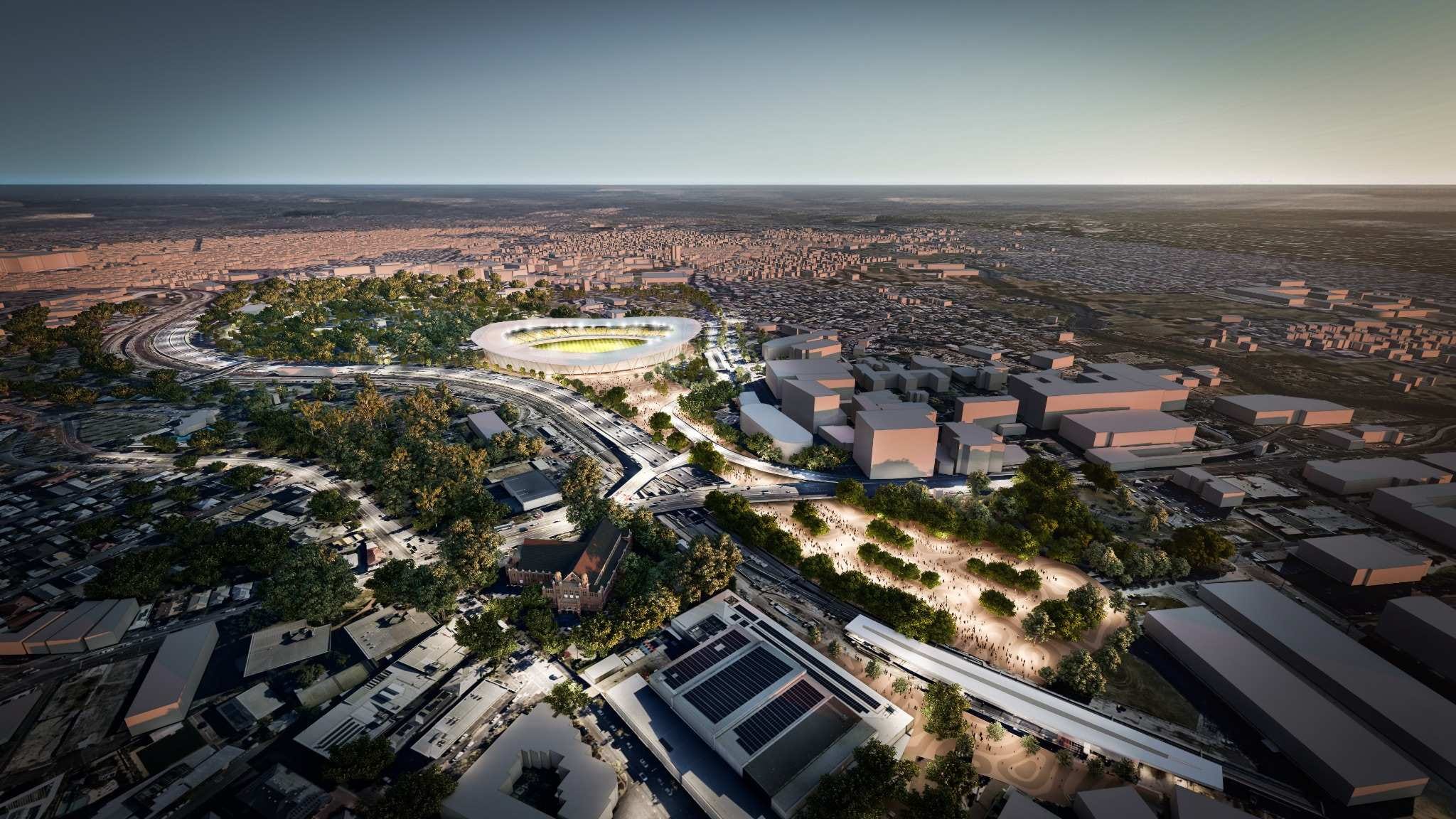
The digital twin is the layer that gives that reality structure. It’s not just a 3D model of stands and seats. It’s the contextual fabric that tells every other system where it lives. It defines the relationship between a sensor, a gate, and the concourse it occupies. It knows that Gate 7 leads to Section D, that Section D holds 4,200 people, and that 12 percent of them are likely queuing for food at halftime, or at end of next heats.
Ten years ago, that kind of intelligence was called visualisation. It was a dashboard with geometry. Today, it’s becoming governance. Bentley, Esri, and Hexagon see it. So do the digital-engineering teams inside stadium operators and city councils. Las Vegas runs on it. The twin has evolved from static architecture into a living spatial framework that anchors decisions in reality. It’s where the geometry of the physical world meets the semantics of data.
When a sensor trips, the twin gives it meaning. When a maintenance task is triggered, the twin places it in space. When a workflow is launched, the twin defines its scope. Context becomes the control plane. It is the quiet source of truth that keeps data from floating free of the world it’s meant to describe.
But context alone can’t keep up with movement. On match or event day, a stadium isn’t static. It breathes. And that’s where the next platform comes in.
By the moment the event starts, whether it’s a match or a medal race, the digital twin understands the environment, while the network understands the activity within it. It knows the moment.
Every tap of a turnstile, every phone connecting to Wi-Fi, every surge of foot traffic from the nearest public transport hub, the network senses it first. In a modern stadium, connectivity is no longer a utility. It’s actually a nervous system. Thousands of access points, edge switches, and antennas feeding a live pulse through the environment. Extreme Networks calls it “network as experience,” and that’s not marketing hyperbole. It’s a statement of architecture.
On game day, the network becomes the bridge between movement and meaning. It knows when a stand fills unevenly and can redirect fans through alternate gates. It detects congestion at food outlets and pushes alerts to digital signage. It powers dynamic advertising boards that change based on crowd composition, location, or even sentiment. It feeds anonymised analytics back to transport operators to synchronise departures at the end of proceedings.
Every packet of data tells a small story, whether it is a path, a delay, or a choice. And together those stories form a real-time map of human behaviour. That’s why sensing has become the new competitive advantage. It’s not about signal strength anymore, but situational awareness.
And yet, awareness doesn’t equate to action. Knowing that a crowd is forming at Gate 4 doesn’t disperse it. Detecting a security anomaly doesn’t resolve it. Sensing is only valuable when the system can respond. That’s where the third layer, the service platform, comes in.
When you can observe but not intervene, clarity becomes its own kind of pressure. It means the system is fundamentally incomplete.
In a connected stadium, thousands of micro-events unfold every second. A sensor detects rising CO₂ in a corporate box. A payment terminal goes offline in a bar. A Wi-Fi access point overheats above Section F. A floodlight trips on the northern stand. Each alert is meaningful, but without coordination it’s chaos.
The service platform is where those signals become decisions. It’s the layer that translates sensing into action and where telemetry turns into a ticket, a workflow, or a dispatch. Platforms like ServiceNow are increasingly acting as the orchestration brain in these environments. They link the physics of the twin and the pulse of the network to the operational routines of human teams.
When a cooling unit fails, the network senses the drop in performance, the twin knows its location, and the service layer automatically assigns a technician complete with route optimisation, part availability, and escalation protocols if the fault affects broadcast integrity. The system doesn’t just notify someone. It mobilises the right response.
That response extends beyond maintenance. The same service logic drives the fan experience by triaging support queries, coordinating lost-and-found incidents, and dynamically updating digital signage or transport information. When a thunderstorm rolls in, the platform can trigger automated messages across screens, social channels, and the transit API all in a single orchestrated act of service drawn from dozens of sensing points and one shared context. Action is the visible edge of architecture. It’s how design becomes experience.
Let’s scale this up. A stadium is a microcosm of a city. It has transport, energy, retail, safety, waste, water, and Wi-Fi all compressed into a few square blocks and a few decisive hours. It’s a system of systems with no margin for error. If you can govern a stadium digitally, you can govern almost anything.
But in practice, few environments are governed by a single authority. The modern campus, whether a stadium, hospital, port, or recreation precinct, often sits at the intersection of public and private control. Local government owns the land, maybe even the facility. State agencies regulate safety and transport or co-locate adjacent premises or share infrastructure hubs. Private operators manage the facilities. Vendors and contractors own the data pipes, the cameras, the kiosks, the fibre, even the lights. Each layer of ownership comes with its own systems, contracts, and accountabilities.
That’s what makes the campus such a compelling modelling framework. It exposes the messy middle ground where infrastructure meets jurisdiction and where the problem isn’t just technical integration but institutional alignment. Who decides when every system has a stake? Who governs the shared space between ownership and operation? These has been one of the key challenges of Macquarie Point for over a decade.
The answer will vary by place, but the 3-platform architecture won’t. Whether public or private, the path forward still depends on the alignment of context, sensing, and action. The same logic scales outward. A streetlight isn’t that different from a floodlight. A bus interchange isn’t that different from a gate. A council operations centre isn’t that different from a control room. What changes is the number of owners and the complexity of consent.
When these three platforms align, we stop managing assets and start governing environments. Cities and campuses alike become living, responsive systems, just like organisms that can sense, think, and act with intent, even across boundaries.
So here’s the rub. It only works if the data can move between jurisdictions, stakeholders and platforms securely, predictably, and with consent. In a stadium, that means Wi-Fi telemetry owned by a network partner may feed into an incident workflow managed by a facilities contractor, which depends on spatial context from a digital twin licensed to a different entity altogether. Each stream is vital, and each is owned by someone else.
That’s why the real foundation of this architecture isn’t just technology. It’s shared data governance. That’s just fancy language for a practical framework for how data crosses boundaries without losing its lineage or trust.
In most environments, those capabilities sit within the service platform layer. It’s the part of the stack that can enforce access rules, orchestrate data flows, log decisions, and record who acted on what signal. It’s the connective layer where operations meet accountability. In that sense, the service platform isn’t just the place where things get done but the place where governance lives.
The three-platform model doesn’t magically solve the governance problem, but it does give it shape. It also reveals the complexity of where ownership must be defined, where agreements must exist, and where the friction still sits. For some organisations, it will remain a reference model that guides decisions even if full alignment remains out of reach. For others, especially those managing complex shared spaces, it offers a blueprint for building genuine interoperability between people, systems, and intent.
Because in the end, context, sensing, and action aren’t separate domains. They’re three ways of describing the same pursuit. That is, turning a world full of signals into one that can think, decide, and act together.
Most campus-scale and city-scale digital transformations have stalled, and will keep stalling, for a simple reason: they are trying to connect a landscape that was never built to be connected. For years, even the largest asset-engineering firms have tried to bridge that divide through modelling and spatial mastery, but the systems they interface with were never designed to operate as one shared experience.
The converged environment stack I’ve written about here is the pattern that finally closes that gap. It anchors the architecture, maps the ecosystem, and makes the structural gaps impossible for both organisations and their supplier ecosystems to ignore.
One of the clearest is this. Digital engineering firms are world-class in physical and spatial data, but they remain weak in the platform layer that actually orchestrates the organisation. Whereas the opposite is also true. IT-led PaaS capability alone can’t win the campus either. Spatial brilliance without service orchestration, and service orchestration without spatial truth, leaves the transformation unfinished.
Until engineering capability and platform capability converge, the outcomes leaders are seeking will continue to stall at the edge of the models they create. But there is a way.