
IBM and ServiceNow Are Converging on the Same Layer of the Enterprise
Competing to Define What Work Is

One of the more interesting dynamics in the enterprise AI and workflow market is how it is beginning to reshape established ecosystem relationships. Take, for example, that between IBM and ServiceNow. This is not a marginal partnership. It spans resale, implementation, co-selling, and increasingly joint positioning around AI and workflow. While no single value is disclosed, the economic weight is significant. In APAC alone, IBM’s influence across these channels is likely in the range of $200–300 million annually, with the global figure considerably higher. More importantly, the downstream value through transformation and services is materially larger.
What is now emerging is not a breakdown of these relationships, but definitely a redistribution of the regional TAM for workflow authority.
With offerings like watsonx Orchestrate, IBM is increasingly able to challenge ServiceNow in sectors such as banking, telecommunications, and the public sector. Particularly in APAC, where complexity, legacy integration, and architectural control are critical. This introduces the potential for meaningful headwinds, possibly approaching $1 billion over five years at the upper end of scenarios.
I’m not saying this should be interpreted as a direct loss. But we should see it for what it is. An ongoing contest over who owns the execution layer. To be successful IBM does not need to displace ServiceNow wholesale. It only needs to win in environments where workflow is inseparable from data, infrastructure, and legacy control.
In APAC, where ServiceNow’s revenue base is approximately $1.5 billion and growing toward a $3–4 billion opportunity over the next five years, the battleground is not just Net New ARR. It is also NRR under pressure. Not just who owns the installed base (which is the old business model), but who captures the next layer of spend within it (the new business model). IBM’s architecture-led, distributed execution model creates a very credible techncial pathway to intercept new regional spend that might otherwise default to ServiceNow.
The likely outcome is a selective diversion of high-value growth segments, particularly in industries where architectural authority remains contested. Framed this way, a $300–700 million shift over five years could be a reasonable expectation, with a $1 billion scenario representing the upper bound if IBM consistently captures complex, AI-led transformation programs. Of course, that’s just head-to-head and doesn’t factor other major players in the AI and workflow ecosystem aggressively positioning for market share.
Regardless, the strategic implication is clear. This is less about platform competition and more about who defines how work is executed in the next generation of enterprise architecture. That is exactly IBM’s point of entry. Let me explain the breakdown.
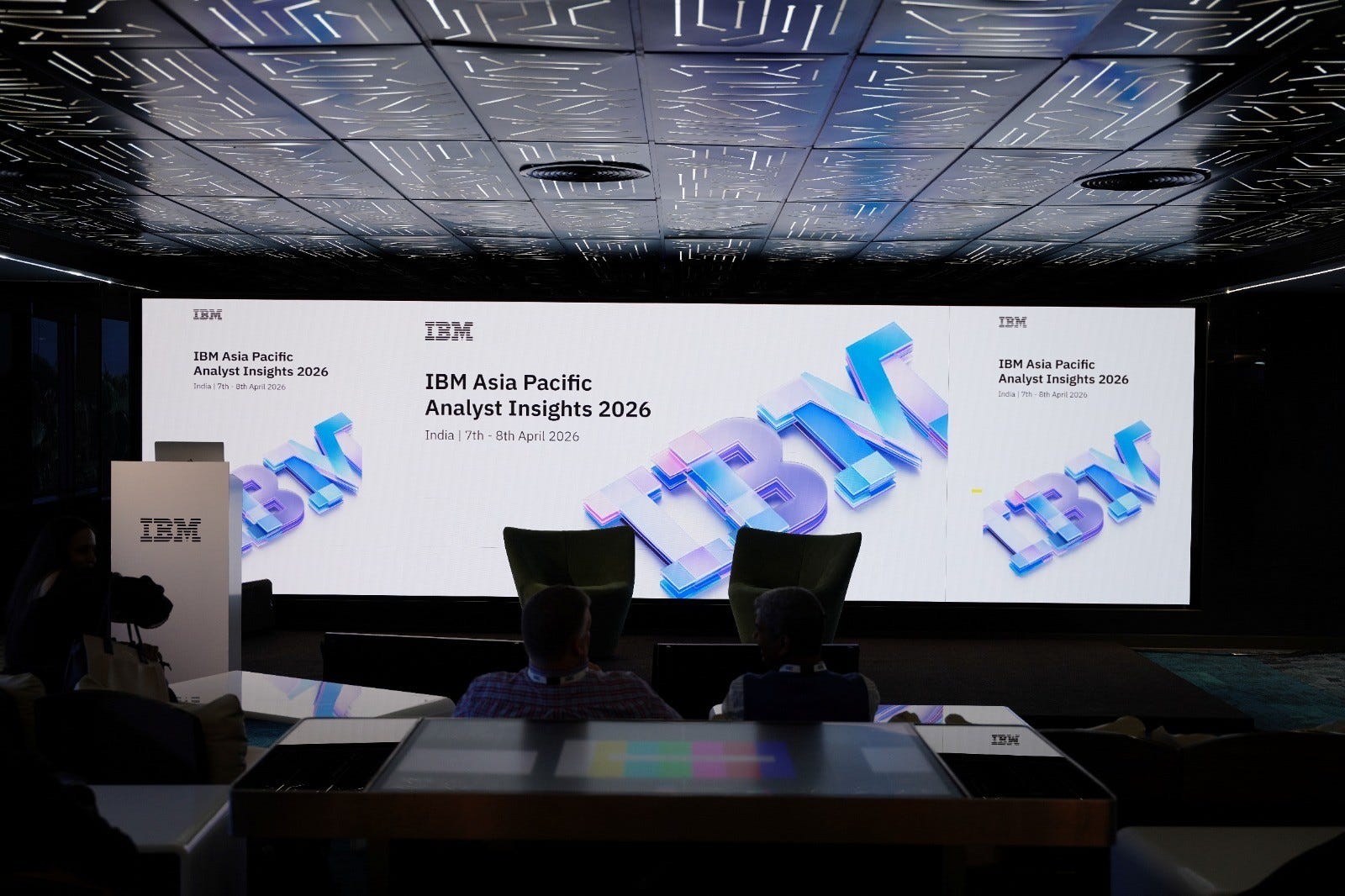
I recently spent a few days in Bangalore at IBM’s Asia Pacific analyst event, Insights 2026. They apply transformation across a set of capabilities that, in reality, operate in multiple directions at once. So it included a broad sweep across AI, data, and hybrid cloud, alongside extensive conversations with consulting teams and enterprise clients, including captive centre operations customers.
These sessions are always valuable because you get close to the thinking and hear how the company wants to be understood. But they don’t present a fully resolved picture. They don’t explicitly show how the pieces fit together. That part is left open. And that creates a familiar challenge. The more comprehensive the briefing, the harder it becomes to see the underlying shape of the real strategy.
So while IBM didn’t frame it this way, sitting there it was already starting to become clear to me that what I was hearing wasn’t just about the convergence of their AI, Hybrid and Data portfolios. It pointed to something more structural. A convergence towards the same layer of the enterprise that platforms like ServiceNow have defined.
Then, on the flight home, somewhere between Singapore and Brisbane, that picture sharpened in an unexpected way. A targeted email campaign promoting discounted SME offers across IBM’s core portfolios.
At face value, it was unremarkable. Just low-cost entry points into watsonx, data platforms, and hybrid cloud. But in the context of the previous few days, it changed the question from “what does IBM sell?” to “what are those pieces designed to become when you put them together?” Because that’s no longer a product question. It’s a platform one.
And when you look at it that way, the answer becomes clearer. An SME would typically buy a packaged application from an ISV. IBM is now selling the components to build that application. So while I’ve been critical in the past of its liberal use of the word “platform”, in 2026 I saw clear evidence that it is starting to execute in a way the PaaS market, and its enterprise consumer base, will recognise.
At enterprise scale, IBM is not easy to read cleanly. The most useful signals don’t come from how it describes itself, but from how each layer of the portfolio is now being positioned. It spans too much of the market to fit neatly into a conventional category. In my own filing structure, it effectively sits under “Vendor” and then “Mega Vendor,” because anything more precise quickly breaks down. It is not just a cloud provider, not just a software company, and not just a consulting firm, even though all three remain central to how its capabilities are delivered and realised.
So rather than trying to categorise it, the better way to understand IBM is to look at how it is organising itself. Increasingly, that comes down to three core domains that the market typically treats as separate.
AI, represented through platforms like IBM watsonx, promise not just model access but governance, auditability, and control. Data, increasingly anchored in offerings like IBM watsonx.data, which attempt to unify structured and unstructured information into something that can actually support decision-making. And hybrid cloud, underpinned by Red Hat OpenShift, which provides the execution environment across on-premise and public cloud infrastructure.
Seen together, the portfolio has, for some time, felt like a collection of adjacent bets. Coherent at a strategic level, but more of a vision than an operating model. The “old” IBM, viewed through the lens of a large enterprise, typically required translation, alignment, and a level of architectural intent that only existed in pockets.
This is why IBM has often appeared complex and fragmented. Not because the pieces didn’t logically fit, but because, without the involvement of IBM Consulting, they were rarely brought together as a unified system.
That’s the enterprise view. But what happens when you strip all of that away? The SME lens forces a different question. What would I actually use here? And when you look at IBM through that lens, the portfolio stops behaving like a set of products and starts behaving like a system.
Because while an SME might ask, “what would I actually use?”, the reality is they are still dependent on everything that sits beneath it whether that is identity, data, workflow, integration, and governance. So the platform doesn’t go away. It just becomes invisible, and unavoidable.
IBM is now behaving like a platform in a way that becomes visible when you strip away enterprise complexity.
Increasingly, those dependencies are being organised around how work is actually executed. From a distance, the inclusion of AI in these SME offers looks like a standard market move. Discounted access to models. Credits for experimentation. A pathway into generative AI. But through the same lens, the dependency becomes obvious.
In the IBM model, AI is not intended to sit on top of work. It is designed to operate where work is already structured, observable, and governed. And that is the catch. Because creating that environment still requires significant process and data alignment. And these are areas where IBM Consulting has been deeply involved. The platform may now be visible, but it still needs to be assembled.

Without that, the models have nothing meaningful to act on. The outputs become inconsistent, the risk becomes unmanageable, and the promise collapses into novelty. So what looks like an AI entry point is actually another platform signal. AI is not something you add. It is something that emerges once work is already structured, observable, and governed. In other words, it operates at the level where work is actually executed.
The same pattern holds when you look at the data layer. At enterprise scale, the language of data fabric and lakehouse architecture suggests consolidation and opportunity. It offers a pathway to unify data and unlock value through analytics and AI. But at SME scale, it feels very different.
It exposes fragmentation, inconsistent definitions, and multiple versions of the same truth. Systems that were never designed to speak to each other are now being asked to form a coherent picture.
In that scenario, what is being offered is not just a platform, but a confrontation with reality. Data, in this context, has little value because it exists. It becomes valuable only when it can support execution and when it can inform decisions in a way that is consistent, auditable, and repeatable.
And then there is hybrid cloud, through platforms like Red Hat OpenShift. Outside of enterprise, the ability to run workloads anywhere and move between environments is often framed as optionality. But even from an SME perspective, that framing eventually breaks down.
You don’t just need hybrid cloud when your environment is already complex. Or when you are operating across multiple systems, multiple vendors, and multiple constraints. Or when control becomes more important than simplicity. You also need it through outages, geopolitical disruption, or supply chain failures like we’ve seen in recent weeks across the middle east. In that sense, hybrid cloud is not about infrastructure flexibility. It is about maintaining control over how work is executed in the presence of complexity.
Across all three layers, the pattern is the same. The value only materialises when it connects to how work is actually carried out. But then when you bring these three layers together, something shifts. AI, data, and hybrid cloud stop behaving like separate portfolios and become interdependent. All of a sudden this is not a collection of software infrastructure tools. It is an operating model.
And once you see IBM through this lens, the rest of the market does not simply sharpen. It starts to overlap. And that will have consequences.
So what does this mean in practice for the enterprise buyers and architects currently redefining their AI and platform strategies? Because once you strip it back, the market is no longer organised by products. It is organised by where work begins, where it is executed, and who controls it.
Microsoft still owns the broadest entry point for now. It sits where people interact with work. It makes AI immediate, accessible, and embedded in the tools that organisations already use. That position is not under threat in the near term. If anything, it is expanding, albeit with some opaqueness around its new AI-enabled E# licensing models.
ServiceNow has spent the last decade building something different. Not productivity, but execution. And the last two years re-establishing around being the platform where work is defined, routed, governed, and completed. Its language is increasingly consistent across workflows, data models, and systems of action. More recently, promoting the idea of a control plane for how work moves through an organisation.
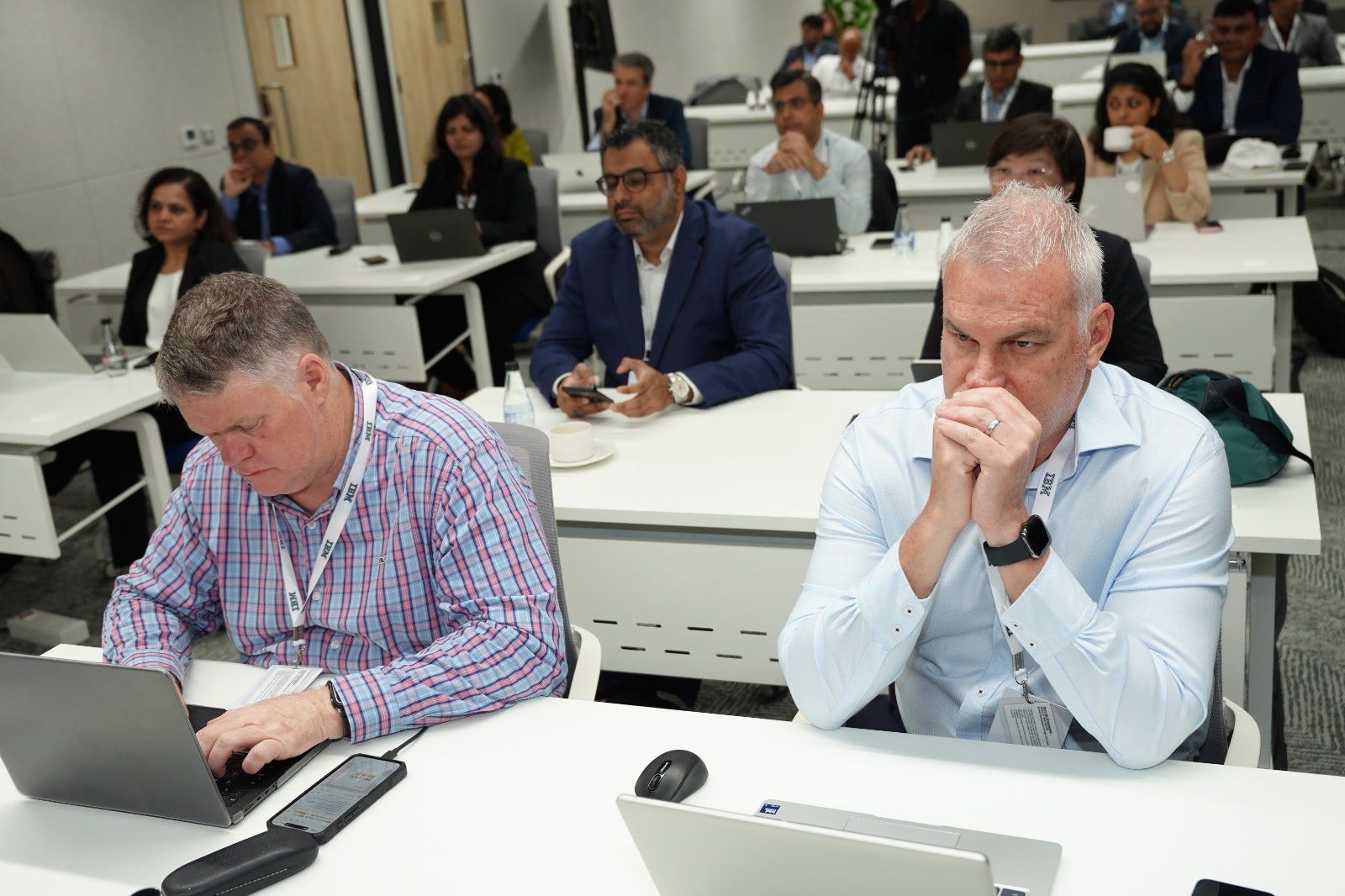
What became clear in Bangalore is that IBM is now speaking a language that is uncomfortably familiar. Its framing is no longer confined to infrastructure, data, or models, but is now led by workflows, orchestration, and control towers. It is moving into observability of the execution layer and into the domain of how work itself is coordinated and governed. This is not a coincidence. It is a signal.
Because it means the market is no longer cleanly segmented into layers. It is converging around the single question of who owns the system that defines, governs, and executes work? ServiceNow were first to get that right.
In that context, IBM is no longer a deep architectural layer. It is reaching upward, attempting to connect its strengths in AI, data, and hybrid cloud into a model that can participate directly in execution. At the same time, ServiceNow is moving downward by strengthening its data foundations, expanding its AI capabilities, and positioning itself as more than just a workflow engine. Microsoft continues to expand laterally, embedding AI and automation into every surface where work begins.
This is what co-opetition looks like in platform markets. The map is being rewritten, and the boundaries are no longer fixed. They are being actively contested.
So how does it stack up? I think IBM’s integrated portfolio spanning AI assistants and agents, middleware, data services, hybrid cloud, infrastructure, and its broader ecosystem, brings something genuinely distinct to the agentic workforce discussion. You can also read some of my earlier thoughts on IBM here (Agentic AI’s Narrow Door).
Right now, its strength lies in environments where complexity, regulation, and scale demand control. Where governance is not optional, and where execution must be observable and auditable across fragmented systems. As the conversation shifts from data sovereignty to AI sovereignty, that positioning becomes increasingly important.
Even more so when you consider that, according to IBM’s own recent CEO study, fewer than 16% of organisations have deployed AI at an enterprise-wide level. But the direction of travel is clear. It is no longer enough to provide the layers beneath work. Rather, every major platform is now moving toward owning the system through which work is actually carried out.
If a further proof-point was needed, IBM’s rollout of the watsonx.data Context Layer, effectively a context graph and semantic ontology layer, is another clear signal of where it is heading. This is a great move by IBM and is not just about improving data access or analytics but about defining how data relates to work.
And that moves IBM directly into territory that has historically been owned by ServiceNow. Because at its core, ServiceNow’s strength has never just been workflow. It has been the ability to model the relationships between services, systems, and processes in a way that allows work to be consistently executed.
What IBM is building through its context layer is not just a data capability. It is an alternative path to the same outcome ServiceNow has been pursuing. ServiceNow started with workflows and built a data model (CSDM) around them. It is an area I’ve long thought they have underplayed and under-promoted so it will be interesting to see how hard and visbily IBM will push Context Layer. They seem to be starting from the opposite direction by establishing the relationships between data, systems, and entities, and using that to inform how work should be understood and executed.
It is a subtle shift, but an important one. Because while literally everyone is now talking about workflows, the platform battle is shifting from “who runs workflows” to “who defines what things mean.” So it clearly spotlights that whoever orchestrates work must be able to define the ontology of the enterprise itself. That is the layer that ultimately determines how work can be executed, governed, and scaled. I’ve previously written about that here.
IBM’s approach to identity within this model also becomes critical. Whether it aligns to an existing framework or establishes its own will determine whether it converges with platforms like ServiceNow, or creates a parallel model of enterprise control.
Returning to the original arc, for most small and mid-sized organisations reading that marketing email, IBM’s SME offers would feel like overreach. Too much capability. Too much implied complexity and too far removed from immediate needs. And in many cases, that instinct will be correct. That’s why IBM Consulting features so prominently in so many IBM enterprise deals. But that is not the point.
The value of looking at IBM through an SME lens is not to determine whether an SMB should adopt the full stack, they clearly shouldn’t. It is to understand why the stack exists at all.
Because what appears excessive at small scale is necessary at medium to large scale. And more importantly, it reveals the direction of travel. We are moving away from a world where organisations buy software to support tasks. Towards a world where platforms define how work is structured, governed, and executed.
So at this inflection point, the easiest way to consider IBM’s relevance in the platform market is not to start with its largest customers, but to strip the problem back to its simplest form. Because when you do, what remains is not a story about AI adoption or cloud migration. We are well past that. It is a highly trusted and capable transformation blueprint for what work will look like in the next decade.