
Assessing the Impact of ReadyTech’s Consolidation Strategy on the ANZ Local Government Software Market
A 100-Day Roadmap to Mitigate Risk and Guide Decision-Making for Council ICT Leaders

The local-government ERP market across Australia and New Zealand is much larger and more diverse than it appears at first glance. Across the two countries, more than six hundred councils operate with wildly different scales and technology needs. The top hundred are substantial organisations in their own right. These are large, complex technology consumers with multi-million-dollar systems and dedicated internal capability.
But beyond that top tier lies the overwhelming majority of the market. These are the SMEs of local government. These are the regional, rural and remote councils with small teams, tight budgets and limited capacity for disruption. And it is this long tail, rather than the metropolitan giants, that has shaped the character and behaviour of the ERP market for decades.
At this level, the ERP landscape has existed in a kind of quiet equilibrium, shaped less by strategy than by inertia. Nothing moved quickly, nothing broke loudly, and most councils simply stayed with the systems they had because staying put for under a hundred thousand dollars a year felt easier than confronting the cost, risk and complexity of change.
Vendors servicing this end of the market didn’t push too hard because they didn’t have the resources. And the idea of a regional tender cycle was as unlikely as a sudden population boom in the Nullarbor. Everyone simply lived with what they had, and while what they had was rarely good enough, it was predictable.
ReadyTech shattered that equilibrium.
What began as a confident consolidation play has become one of the most consequential market disruptions the sector has seen in years. Not because they set out to create disruption (though of course it did that), but because the act of trying to lock the market down has ended up stirring it awake.
Consolidation is usually intended to bring order, clarity and growth. It’s the kind of move that’s meant to settle a market, not stir it. But in this case, the immediate effect has been the opposite. Instead of settling, the market has begun to move. Once that happens, it rarely does it quietly. It’s a tight knit sector, and a re-evaluation that begins in one region quickly becomes a conversation across many, and the ripple effects take on a life of their own.
The long tail of Australian local government which includes the shires, the regions, and the remote authorities working with minimal staff and maximal expectations, spent years inside systems like SynergySoft, Open Office, CouncilWise (PropertyWise) and the rest of the small-vendor constellation.
These products were built in a different era, shaped as much by the preferences and philosophies of individual developers as by formal product strategy. Over time they accumulated their own folklore. Passing from hand to hand and rewritten across technological epochs. From early proprietary frameworks, through the VB6 years, and eventually into the kernels of the modern platforms we see today.
Patches layered on patches, customisations handed down across IT officers like a set of inherited tools. The products became familiar in the way old houses are familiar. But that familiarity always sat alongside the fatigue of technical debt and the quiet knowledge that the foundations were ageing faster than the councils could ever adapt.
Many of these companies had essentially sidestepped the full SaaS re-architecting journey that today’s contemporary software vendors undertook over the past 15-years. Their platforms carried years of incremental adaptation rather than a ground-up rebuild for the cloud era. So when ReadyTech bought IT Vision in 2022, Open Office and Open Windows in 2021, and CouncilWise in 2025, it didn’t just acquire customer bases. It inherited a complex landscape of legacy technologies, long-held customer expectations, service anxieties and decade’s worth of unresolved architectural decisions. What looked like a consolidation play on the surface was, in reality, a massive integration and modernisation challenge beneath it.
From an analyst’s perspective, the goal of these acquisitions was to create a unified cloud pathway under the Ready Community banner. Great. But bringing several long-standing systems, architectures and deeply embedded customer histories into a single platform is a complex, multi-(multi)-year exercise. I think the gap between the long-term vision and the immediate product reality was visible to councils, and to analysts, from the outset.
The moment the consolidation became real, councils in South Australia and Western Australia found themselves exposed to a new kind of question. WA in particular, with its deep SynergySoft footprint, probably felt the tremor first. SA was close behind, shaped by its own mix of Open Office and CouncilWise installations.
Entire regions began to look at their systems not as fixed assets but as things that now demanded re-evaluation. In 2025, conversations that had been dormant, sometimes for decades, suddenly became urgent, and competitors immediately recognised the moment.
Vendors who had struggled for visibility in certain states found doors opening that had been shut for a generation. They moved quickly, not because councils were suddenly dissatisfied, but because the conditions for change had finally appeared. The shift created a window of opportunity, and the market did what markets always do when stability dissolves. It flowed into the space that uncertainty created.
This would not have happened without ReadyTech.
Councils in the smaller tiers rarely pursue ERP renewal unprompted. Their operating reality is defined by immediacy. They have limited staff, tight budgets, visible risks, and a constant pressure to keep services running with as little disruption as possible.
Technology is often framed as an essential cost rather than an enabler of transformation, which means the perceived return on a major systems overhaul rarely outweighs the effort required to deliver it. In environments like this, large-scale change doesn’t emerge organically. It takes an external jolt to surface the question, and that is precisely what happened here.
They were pushed into clarity by the uncertainty that supplier consolidation always brings. When a familiar vendor disappears into a larger structure, even if the intention is good, the relationship changes. It doesn’t matter if it is IBM or Salesforce or in this case ReadyTech. Customers want to know what comes next, when it comes, and how far away next actually is.
ReadyTech offered a paper vision in which everything converges into a single cloud platform. The vision was attractive, but the details and the timeline were not. A vision without specificity becomes its own form of disruption, because it requires customers to imagine the gaps for themselves. And when councils are already relying on the day-to-day performance of their incumbent system, that ambiguity doesn’t inspire confidence. It actually amplifies the sense that the future is being asked of them before the present is fully resolved. The more opportunities councils had to look at the unified future, the more they realised that much of it was still being built. And the more they realised that, the more they looked outward.
This is how MAGIQ found itself with an open door in regions that had resisted change for decades. The company has followed its own long arc of acquisition-based evolution, not unlike ReadyTech’s, and not without its own challenges, but the crucial difference is timing. MAGIQ arrives at this moment with a cloud ERP and solution portfolio that is largely coherent and deployable. In many ways, it is benefitting from the conditions ReadyTech created.
The simplicity of a platform that is fully formed and available now becomes a powerful antidote to the uncertainty that consolidation has introduced. CouncilFirst has found a similar opportunity, not by promising simplicity but by grounding itself in something even more reassuring. Microsoft. A D365 ERP looks less like a leap of faith in 2025, and more like an extension of the tools that councils already trust, with regional skills they have, in an environment they know.
None of this was inevitable. ReadyTech created the conditions. The consolidation strategy brought three very different ecosystems into the same gravitational field, but unity in structure has not translated neatly into unity in customer expectation. A SynergySoft council in WA has different needs to a CouncilWise customer in SA or TAS, and each differ again from the councils shaped by Open Office’s regulatory workflows. From what I have observed, each group was told it would be part of a bigger future without clearly seeing how their present would actually merge into it.
As soon as one council in a region began to reassess its position, its neighbours followed. Market testing is contagious. Tenders are even more so. Councils talk, especially in SA and WA, where the distances are vast but the community of practice is tight. A single reassessment in the Wheatbelt becomes a conversation across half the state. A moment of doubt in the Adelaide Hills reverberates along the Limestone Coast.
This is why South Australia and Western Australia became the epicentre of local government ERP movement in 2025, and why 2026 looks set for even greater disruption. These states held the highest concentration of the legacy systems that ReadyTech absorbed. When those systems were lifted under a new umbrella, the stability that once held them in place dissolved.
Once councils stopped looking at this as a technology review (an area where confidence is often low), and instead began reviewing something they understand intimately (risk, autonomy and future dependency), the logic changed.
For the first time in a long time they felt responsible for questioning the structures that would shape their future. Were they really bound to the systems they had? And the moment the conversation moved out of software features and into organisational control, the door opened for every competitor in the market.
The irony is that ReadyTech has done nothing wrong in strategic terms. Consolidation was always coming. And consolidation will continue. The long tail was never sustainable. Obsolesence has been marching closer every year. The sector needs modernisation, clarity and investment. ReadyTech tried to bring all three at once. But timing matters, sequencing matters, and executable roadmaps matter more than ever in a sector that has lived with legacy debt for a generation.
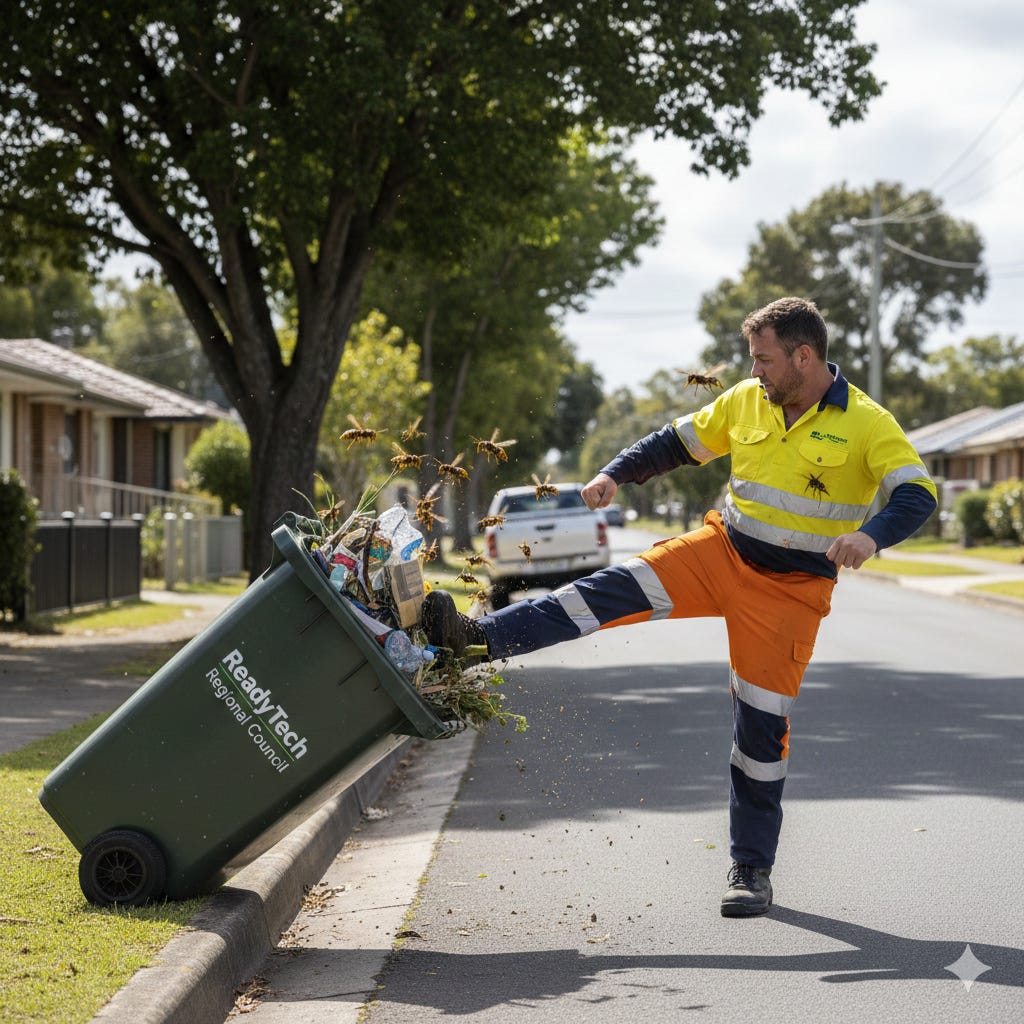
And so the hornet’s nest was kicked. Not because ReadyTech intended to provoke the swarm, but because the pressure of consolidation was applied before the structure beneath it had settled. The result is a market that is suddenly louder, faster and more liquid than it has been in twenty years.
MAGIQ, itself a slow burner over the last decade, is winning councils it never would have reached before. OST is entering conversations that were closed to it just a few years ago. Datacom has a message. Even TechnologyOne is finding fresh attention in places that once dismissed it as too large or too costly.
ReadyTech may still emerge stronger but that will only become clearer in 2026. It is worth noting that their share price (ASX: RDY) has fallen by roughly 25 per cent over the calendar year. That movement reflects the performance and market sentiment around the entire company, not just the Local Government practice where the IT Vision, Open Office, CouncilWise and Open Windows acquisitions sit. But it is a reminder that the broader consolidation narrative is still being digested by investors.
Whatever the reasons for the decline, it reinforces the point that councils should assess their own risk and dependency positions independently of how the market values the company as a whole. Because being publicly traded also introduces a different set of strategic pressures. Listed companies are required to balance long-term product integration with short-term financial performance, and that inevitably shapes how aggressively they can invest in unifying complex portfolios. Civica’s ebb and flow over many years is reflective of this kind of pressure.
It also means their product mix is not static. Acquisitions can be followed by consolidation, re-prioritisation or shifts in focus as the company responds to market conditions and shareholder expectations. None of this is unusual. But it does mean that 2026 is going to be a critical year for ReadyTech as councils re-evaluate their current state. This includes a clear understanding of the structural realities of a listed vendor, and the strategic adjustments that may yet still occur in this vertical over time.
The advantage of consolidation has been offset by the acceleration of choice for which they have been found unprepared (this year), because the fight now unfolding has very little to do with features on a brochure. It has become a test of trust, of whether councils believe the roadmap is real or merely aspirational, and of whether they can deliver consistency at scale (better than the companies they acquired), rather than promise it in theory.
It is about stability in regions where stability has always mattered more than novelty, and about whether a supplier can speak credibly to long-term data strategy in organisations that barely have the internal capacity to manage today’s demands. Above all, it is about platform alignment and the quiet politics of technology in environments where every resource is stretched, every decision carries weight, and every misstep is felt for years.
In the end, the real story is that this part of the local government ERP market didn’t wake up because it was hungry for innovation. It woke up because its sleep was disturbed. But it is definitely awake now.
ReadyTech didn’t simply trigger an upgrade cycle. In fact, had it left the landscape untouched, I doubt MAGIQ or CouncilFirst would be expanding as quickly into South Australia and Western Australia with the momentum they have today.
The consolidation forced councils to re-examine assumptions they had held for years, and that re-examination opened the door for competitors. Where inertia, not technology, is the mechanism holding everything in place, once a council realises it has options, the entire market changes.
What happens next is where the real tension lies. The decisions councils make from here will shape not just their systems. The implications reach far beyond product choice, touching questions of trust, capability, data, politics and the quiet realities of operating under relentless constraint.
Paid subscribers can read on to further understand what I think it means for the hundreds of councils faced with this decision, and the 100-day plan.